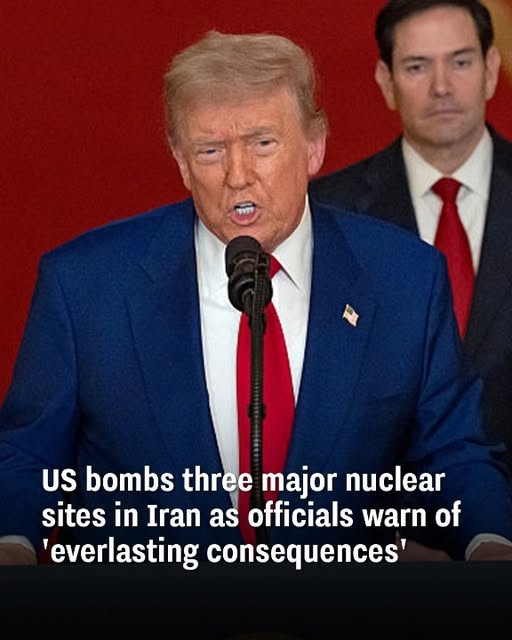
US military targets three critical nuclear locations in Iran while officials promise ‘lasting retaliation’
In a significant escalation of global tensions, President Donald Trump declared a surprise military strike by the U.S. aimed at Iran’s critical nuclear sites located at Fordow, Natanz, and Esfahan. This strike, intended to disrupt Iran’s nuclear enrichment efforts, was prompted by a troubling report from the Institute for Science and International Security that highlighted Iran’s increasing ability to produce weapons-grade uranium.
Trump proclaimed the operation a success and issued a firm warning that additional measures would be taken if Iran did not seek peace. In response, Iran quickly condemned the strike as a breach of international law and pledged to protect its sovereignty.
This action triggered widespread concern, eliciting mixed reactions from global powers and calls for restraint throughout Europe. The International Atomic Energy Agency confirmed that there were no radiation leaks but is continuing to evaluate the damage’s extent.
The strike raises urgent questions regarding its legality, precedent, and underlying motives. Critics contend that the attack lacked authorization from the UN or Congress and accuse the U.S. of sidestepping diplomatic avenues in favor of military intervention.
Comparisons have been drawn to Israel’s preemptive strikes in Iraq (1981) and Syria (2007), both of which faced criticism yet achieved their strategic objectives. Meanwhile, speculation regarding Iran’s potential responses—whether retaliation or a return to negotiations—contributes to global uncertainty.
On the domestic front, this decision is igniting intense debate in the lead-up to the 2024 election, with Trump’s supporters lauding his decisiveness while opponents caution against possible entanglements. As the international community observes closely, this incident represents a pivotal moment for U.S. foreign policy and highlights the pressing reality of the nuclear threat.