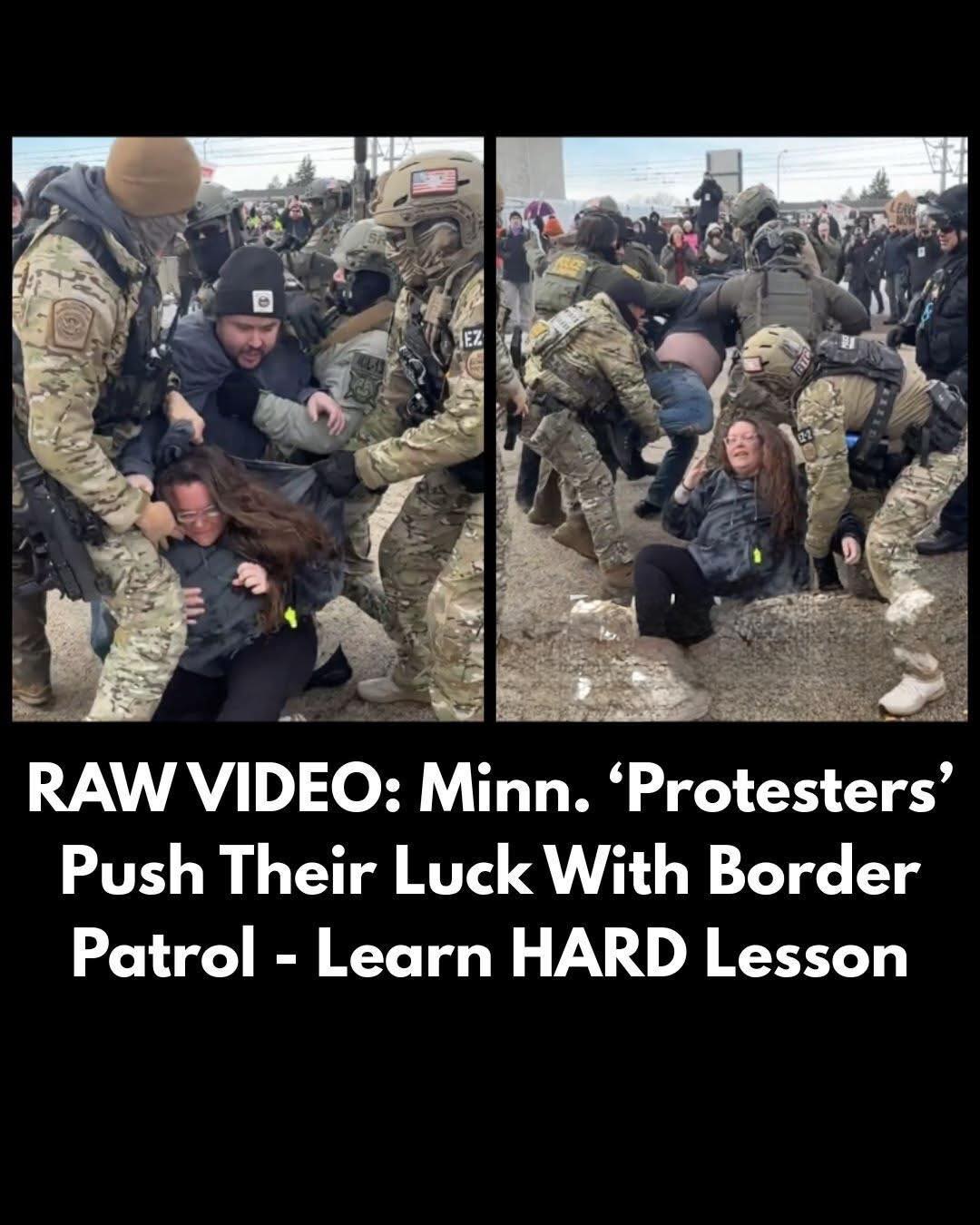
Minnesota Activists Tried to Intimidate Border Patrol — and Found Out the Hard Way
There is a dangerous lie circulating in American politics right now: that federal immigration enforcement officers are some kind of rogue militia, operating outside the law and deserving of harassment, obstruction, or worse. That lie has been nurtured, repeated, and amplified for years by Democratic politicians, progressive activists, and a media ecosystem that treats hostility toward law enforcement as a moral virtue.
What happened in Minnesota this week is the predictable result.
A group of self-described “protesters” deliberately inserted themselves into an active Border Patrol operation, attempting to disrupt officers as they carried out their duties. They shouted, interfered, blew whistles to draw attention, and attempted to assert authority they do not have. And for a brief moment, they seemed to believe that the rules no longer applied to them.
They were wrong.
The Climate That Made This Inevitable
This did not happen in a vacuum. For years, federal immigration agents have been portrayed as villains — not just criticized, but dehumanized. They have been labeled “fascists,” “stormtroopers,” “kidnappers,” and worse. The distinction between lawful enforcement and abuse has been intentionally blurred, replaced with a narrative that any enforcement at all is immoral.
When you tell people, over and over, that ICE and Border Patrol are enemies of the public, you should not be surprised when some of your followers decide to confront them directly.
That is exactly what unfolded in Minnesota.
ref_src=twsrc%5Etfw%7Ctwcamp%5Etweetembed%7Ctwterm%5E2009675513200365703%7Ctwgr%5E13dfb0680246b7c1192d080aa1fb1c620924a082%7Ctwcon%5Es1_c10&ref_url=https%3A%2F%2Fusajournal.news%2F2026%2F01%2F10%2Fminn-protesters-try-to-take%2F
Activists didn’t stumble onto an enforcement scene by accident. They went looking for it. They wanted to interfere. They wanted to provoke. And judging by their behavior, they expected the agents to retreat.
Instead, they encountered reality.
What the Footage Shows
Video captured on the ground paints a stark picture. Border Patrol agents were conducting an operation when activists began crowding the scene. One woman aggressively demanded to know about medical care for a detainee, speaking as though she had supervisory authority. She did not. She was not part of law enforcement. She was not a legal observer. She was an interloper.
Others blew whistles — a tactic commonly used to signal crowds and disrupt operations — effectively attempting to obstruct enforcement. Another activist loudly announced that “ICE is here,” despite ICE not being involved, apparently hoping to summon more protesters or escalate the situation.
And yet, in the middle of this attempted interference, one of the Border Patrol agents calmly warned a protester not to slip on the ice.
That detail matters.
It cuts directly against the cartoon villain image activists want to project. These were not out-of-control agents itching for confrontation. They were professionals exercising restraint, even while being provoked.
Following and Intimidation Cross a Line
The situation grew more concerning when it became clear that Border Patrol vehicles were being followed by multiple cars. Agents reported being trailed during the operation, a tactic that crosses from protest into intimidation.
This is not protected speech. Following law enforcement vehicles during active operations raises serious safety concerns — not just for agents, but for detainees and bystanders. Agents issued warnings and made clear that continued interference could result in arrest.
That, too, is lawful. And necessary.
Federal officers do not lose their authority because someone disagrees with their mission.
Protest vs. Obstruction
There is a critical distinction that too many activists pretend not to understand: protesting government policy is legal; obstructing law enforcement is not.
Standing on a sidewalk with a sign is protected. Inserting yourself into an enforcement action, shouting instructions, blowing whistles, and trailing officers is not.
When activists blur that line, they are not engaging in civil disobedience. They are testing boundaries — often relying on political pressure to shield them from consequences.
But federal law enforcement does not answer to local activist culture. And when that reality collides with protest theater, the outcome can be jarring for those accustomed to impunity.
The Dangerous Escalation Pattern
What makes this Minnesota incident especially troubling is how closely it follows a fatal encounter earlier in the week, when an anti-ICE activist was shot after allegedly attempting to use her vehicle against agents.
That should have been a wake-up call.
Instead, activists doubled down.
This pattern — escalation followed by denial — is becoming routine. Each confrontation is framed as evidence of “militarization.” Each response is described as brutality. And each warning is dismissed as propaganda.
Until someone gets hurt.
Then the same voices that fueled the hostility pretend to be shocked by the consequences.
Political Leaders Fuel the Fire — Then Hide
Perhaps the most cynical aspect of all this is how quickly Democratic leaders distance themselves when rhetoric turns into reality.
For years, they have encouraged non-cooperation, sanctuary policies, and public demonization of federal agents. They have applauded resistance. They have framed enforcement as inherently illegitimate.
But when agents are attacked, when mobs gather, or when confrontations turn deadly, those same leaders suddenly plead for calm and demand investigations — as if they bear no responsibility for the climate they helped create.
You cannot spend years telling people that law enforcement is the enemy and then act surprised when some take that message literally.
Border Patrol Is Not the Villain Here
Border Patrol agents do not write immigration law. They do not set policy. They enforce the statutes passed by Congress and signed into law.
They operate under strict rules of engagement. They are trained to de-escalate. And they are accountable — far more so than the activists who harass them without consequence.
The Minnesota footage shows restraint, professionalism, and patience in the face of provocation. It does not show tyranny. It shows public servants doing a difficult job under hostile conditions.
The Cost of Pretending Law Enforcement Is Optional
Every time activists successfully disrupt enforcement, it sends a message: that federal authority is negotiable, that intimidation works, and that the loudest mob sets the rules.
That message is corrosive.
It undermines the rule of law. It endangers officers. And it ultimately harms the very communities activists claim to defend, because criminal organizations thrive when enforcement is weakened.
Transnational gangs, traffickers, and repeat offenders are not deterred by slogans. They are emboldened by chaos.
Reality Is Not a Hashtag
What Minnesota activists learned — perhaps unwillingly — is that reality does not bend to ideology. Federal agents are not going to abandon their duties because someone blows a whistle or shouts a slogan.
The law still exists. Authority still matters. And actions still have consequences.
If activists continue to insert themselves into enforcement operations, the risk of further confrontations — and further tragedy — only increases.
That is not a failure of Border Patrol.
It is the direct result of a political movement that has spent years teaching people to hate the very institutions that keep order.
Final Thought
Protesters in Minnesota believed they could pressure, shame, or overwhelm Border Patrol agents into standing down. Instead, they were reminded of an uncomfortable truth: federal law enforcement does not operate on vibes, narratives, or activist approval.
And the sooner political leaders stop encouraging reckless confrontations, the safer everyone will be — agents, civilians, and even the protesters themselves.
Because the next time someone decides to “take on” Border Patrol, the outcome may not end with a warning.